
Choosing between two of nature’s most prestigious natural surfaces often leads to a standstill between aesthetic desire and functional necessity. When evaluating the core properties of granite and marble, the main differences lie in their structural durability and mineral composition.
Granite is an igneous rock renowned for its exceptional scratch and heat resistance, making it an ideal choice for high-impact zones like kitchens. On the other hand, marble is a metamorphic stone prized for its elegant veining and classic beauty. However, it is naturally softer and more porous, requiring dedicated maintenance and regular sealing over its lifespan.
This blog simplifies the selection process by breaking down the technical differences in hardness, porosity, and maintenance for 2026. Whether your goal is an unburdened, heat-resistant kitchen workspace or a sophisticated bathroom sanctuary, the following insights provide a clear roadmap to securing the perfect stone investment.
Marble or Granite: Which Is Better for Kitchen Countertops?
Kitchens are high-impact zones where extreme heat, acidic ingredients, and sharp knives present constant structural threats to countertops.
Granite’s Performance Profile
Granite is nearly impossible to scratch under normal residential conditions and easily withstands hot pots placed directly onto its surface. For a busy, high-use family kitchen, an experienced granite & marble supplier will almost always recommend selecting granite for utility areas.
Marble’s Structural Vulnerability
While visually stunning, marble remains highly sensitive to acid etching. Common acidic liquids like lemon juice, tomato sauce, or vinegar can chemically react with the surface of unsealed marble slabs in seconds, stripping away the polish and leaving permanent, cloudy, dull spots behind.
The Kitchen Countertop’s Verdict
Granite wins decisively on daily utility and wear resistance, whereas marble remains the definitive choice for pure, unmatched luxury across lower-impact accent zones.
How Granite and Marble Shape Interior Design Styles
The visual movement of a stone defines the room’s character.
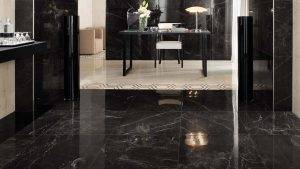
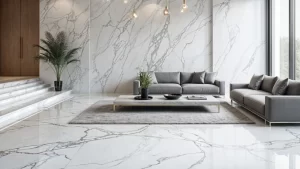
The Look of Marble
Marble is famous for its veining, long, flowing lines of mineral deposits that create a sense of grace. Designers frequently specify Aella White marble because it offers a bright, luminous white crystalline background that traditional granite varieties rarely achieve.
The Look of Granite
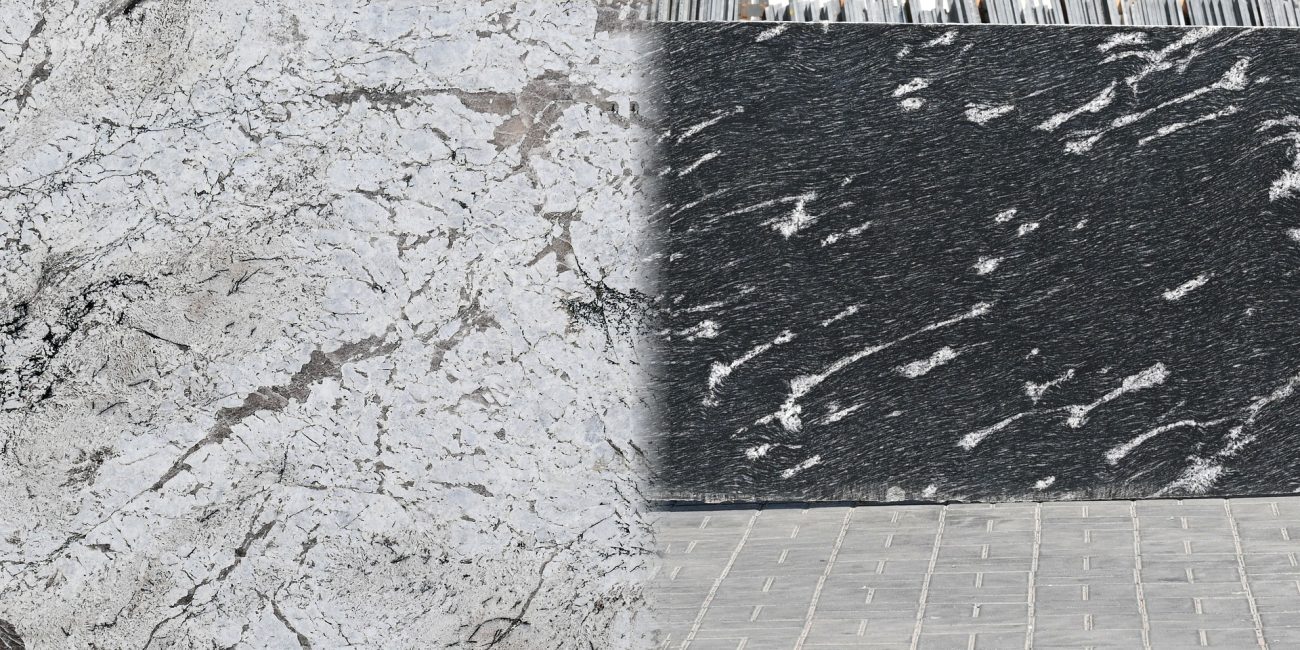
Granite typically features a distinctive “flecks-in-matrix” or granular crystalline appearance. While a few select modern extractions like Mugal White granite feature sweeping patterns that subtly mimic traditional marble movement, granite selections generally present a more earth-toned, granular, and heavily varied colour palette.
Which Stone Requires More Maintenance and Sealing?
Maintenance is the most significant long-term factor when comparing granite vs marble.
|
Feature |
Granite Flooring & Counters |
Metamorphic Marble Stone |
|
Structural Porosity |
Exceptionally Low (Naturally stain-resistant) |
High (Absorbs standing liquids quickly) |
|
Sealing Frequency |
Requires maintenance every 1–2 years |
Requires deep sealing every 6 months |
|
Acid Resistance |
High (Unaffected by household acids) |
Low (Etches rapidly from citric elements) |
|
Surface Repairability |
Hard (Demands specialist tooling) |
Moderate (Can be re-polished and buffed) |
Is Granite More Expensive Than Marble in 2026?
Raw cost is rarely a standalone indicator of material quality; rather, it reflects quarry scarcity, geopolitical extraction difficulty, and current global shipping factors. In the 2026 market, the gap between the two has widened in the ultra-luxury segment but narrowed significantly among standard commercial selections.
- Entry-Level (Budget-Friendly): Common granites, particularly Indian and Chinese varieties, remain the most affordable option for large-scale flooring. They offer high durability at a lower cost per square foot compared to even the most basic marbles.
- Mid-Range (Competitive): Exotic granites with marble-like veining and standard marble slabs (such as Carrara or Crema Marfil) are now comparable in price. Improved quarrying technology has made these accessible for mid-sized residential projects.
- High-End (Premium Investment): Rare marbles, specifically those from heritage Italian, Greek, or Brazilian quarries, remain the most expensive building materials available. These stones are viewed as “appreciating assets” in luxury real estate.
Core Differences Between Granite and Marble?
Understanding the geological differences between these materials helps ensure you select a stone that aligns with your space’s functional demands.
|
Feature |
Granite (Igneous Rock) |
Marble (Metamorphic Rock) |
|
Geological Origin |
Formed from cooled magma/lava. |
Formed from pressurised limestone. |
|
Mineral Base |
Quartz, Feldspar, and Mica. |
Primarily Calcium Carbonate (Calcite). |
|
Visual Pattern |
Speckled, granular, or mottled. |
Flowing, elegant veins. |
|
Mohs Hardness |
6 – 7 (Highly scratch-resistant). |
3 – 5 (Softer; can be scratched). |
|
Porosity |
Low (Naturally stain-resistant). |
High (Absorbs liquids easily). |
|
Acid Sensitivity |
High resistance to acids. |
Highly reactive (Etches from lemons/vinegar). |
|
Heat Resistance |
Excellent (Handles hot pans well). |
Moderate (Can scorch or crack). |
|
Primary Use |
Kitchen counters, high-traffic floors. |
Bathrooms, fireplaces, and wall cladding. |
What Should a Granite & Marble Supplier Check for Large Projects?
A professional granite & marble supplier ensures project success by managing technical specifications that the average buyer and even some contractors might overlook.
1. Advanced Technical Testing
Beyond visual appeal, a top-tier supplier provides laboratory reports for:
- Compressive Strength (MPa): Essential for commercial flooring; it measures the stone’s ability to withstand heavy foot traffic or machinery without crushing.
- Water Absorption Rate: For exterior cladding or bathrooms, a supplier must verify that the stone’s porosity falls within safe limits (typically <0.5% for granite) to prevent spalling or deep staining.
2. Batch and Bundle Control
Natural stone is harvested in “blocks”. A professional supplier ensures that all marble stone for a specific wing of a building comes from the same block.
- Sequence Mapping: They provide a “map” of the slabs, ensuring that the natural veining flows seamlessly from one tile to the next, avoiding the “patchwork” look common in low-quality installations.
3. Resin Integrity and Filling
Many modern slabs are treated with epoxy resins to fill microscopic fissures. While standard, a supplier must check the following:
- Resin-to-Stone Ratio: Over-resined stones can discolour or “yellow” when exposed to UV light or certain adhesives.
- UV Stability: Especially important for projects with floor-to-ceiling windows, the supplier ensures the resin used is UV-stable to prevent fading.
Conclusion
The debate surrounding granite vs marble is not straightforward, as the right choice depends on where the material will be installed and how much daily wear it will experience. Granite serves as the resilient workhorse of the natural stone world, offering unmatched resistance for busy kitchens and high-traffic floors. Marble remains the ultimate artwork, providing a classic elegance that elevates property value despite requiring more mindful maintenance.
By working with a verified granite & marble supplier and understanding the specific needs of the space, one can ensure that the selected marble stone or granite slab remains a centrepiece of the home for a lifetime.
Frequently Ask Question
Which is best: Marble or Granite for bathroom vanities?
Marble is often recommended for bathroom vanities because bathrooms are generally low-traffic and lack the acidic hazards of a kitchen; the beauty of marble can be enjoyed with minimal risk of damage.
Can hot pans be placed on marble?
While marble is heat-resistant, it is not heat-proof. Extreme temperature changes can cause thermal shock or cracking. It is always safer to use a trivet, unlike granite, which handles high heat exceptionally well.
Does granite increase home value more than marble?
Both stones increase value significantly. However, marble is often perceived as a luxury upgrade in real estate listings, which can create a higher psychological value for potential buyers in the luxury market.
How can a person tell the difference between the two at a glance?
Look at the patterns. If the stone has large, flowing veins like ink in water, it is likely marble. If it has a speckled, salt-and-pepper appearance with visible crystals, it is almost certainly granite.
Why do some marbles turn yellow over time?
This often happens due to iron oxidation within the stone when exposed to excess water. Ensuring that a granite & marble supplier provides properly sealed and tested stone can prevent this rusting effect.