
Homeowners often struggle with unexpected renovation costs due to hidden fees and complex material grading. Determining how much for a quartz countertop involves evaluating slab quality, edge profiles, and installation complexity rather than just looking at a sticker price.
By understanding the cost drivers behind engineered stone, buyers can make informed decisions that align with their design goals. In this comprehensive guide, you will learn about material grades, the impact of slab thickness, custom fabrication labour, and the long-term value of choosing the right surface.
Why Is Understanding the Value Factors of Quartz Important?
Quartz is an engineered product, but not all slabs are created equal. Since it is a mix of natural minerals and resin, the ratio of these materials significantly influences the price. A high-quality slab offers better resistance to chips and stains, which provides better value over time. Identifying these factors early prevents the mistake of choosing a “bargain” stone that may require expensive repairs or premature replacement.
How Does Material Grade Affect the Total Cost?
Manufacturers categorize quartz into various tiers based on the complexity of the design and the purity of the minerals used. Unlike natural stone, which is graded on rarity, quartz is graded on its aesthetic and structural properties.
- Entry-Level Grade: Typically features simple, solid colours or fine salt and pepper patterns. These are thinner slabs, often used for pre-fabricated units.
- Mid-Range Grade: Includes more varied colours and slight veining that mimics natural stone like granite.
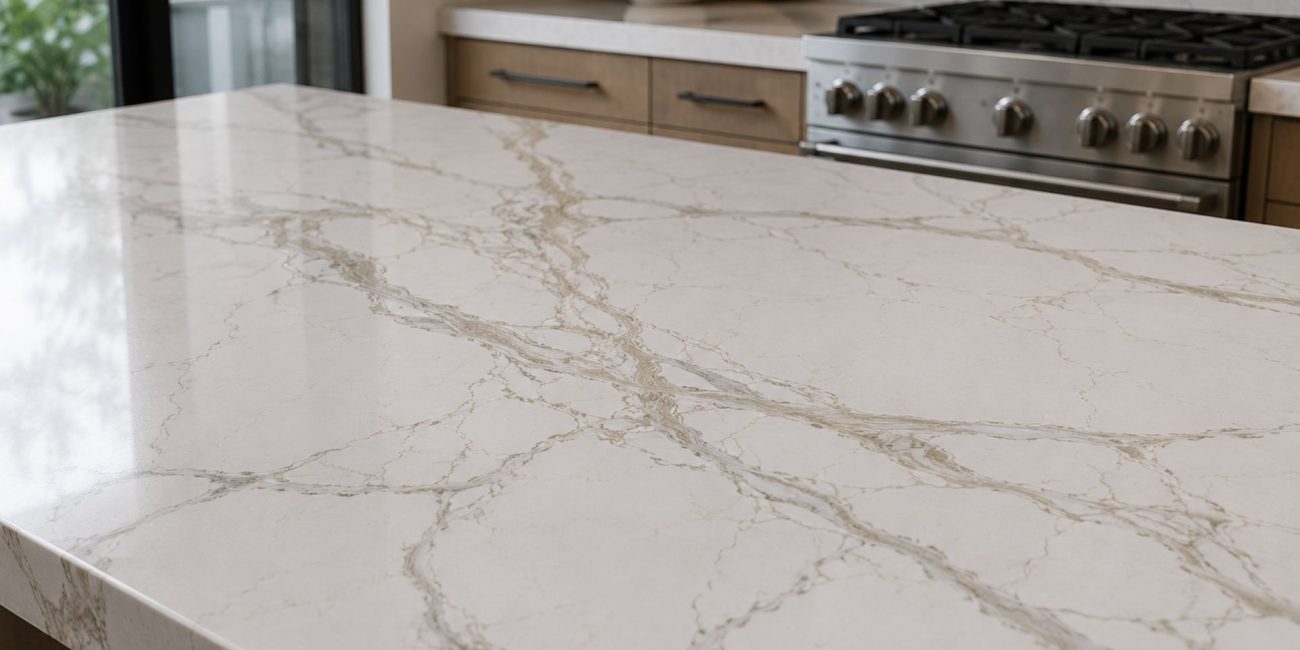
- Premium/Designer Grade: These slabs feature intricate, bold veining that looks exactly like high-end marble. The engineering required to make these patterns look natural is what drives the cost.
| Grade Tier | Best Use Case | Primary Cost Driver |
| Standard | Rental Properties/Laundry Rooms | High resin-to-stone ratio |
| Deluxe | Family Kitchens | More complex pigmentation |
| Supreme | Luxury Showcases | Custom veining and slab size |
What Role Does Slab Thickness Play in Budgeting?
When evaluating the thickness of a slab, you aren’t just paying for more stone; you are paying for structural integrity.
- 2 cm Slabs (Approx. 3/4 inch): While the raw material cost is lower, these slabs are more fragile during transport and installation. Because they lack the inherent rigidity of thicker stone, they typically require a plywood sub-top installed over the cabinets. This requires additional carpentry labour and materials, which can narrow the price gap between 2 cm and 3 cm options.
- 3 cm Slabs (Approx. 1 1/4 inches): These are the gold standard for quartz countertops in the UAE. Their weight allows them to be set directly onto cabinet frames. The primary financial benefit here is the elimination of extra support layers and a more substantial visual profile that increases the home’s resale value.
Edge Profiles: The Labour Behind the Look
The edge profile is where raw stone becomes a custom piece of furniture. The more complex the curve, the higher the fabrication hours.
| Edge Type | Labour Intensity | Aesthetic Impact |
| Eased/Square | Low | Modern, clean, and minimalist. Usually included in base fabrication. |
| Beveled | Moderate | Adds a clipped 45-degree angle that catches light beautifully. |
| Bullnose Half-Bullnose | Moderate | Softens the kitchen’s look; safer for high-traffic areas. |
| Ogee/Waterfall | High | Traditional and elegant; requires multiple passes with hand tools. |
| Mitred Apron | Very High | Involves complex 45-degree cuts to wrap the edge, making a standard slab look like a massive block. |
Why Are Fabrication and Installation So Complex?
The hidden portion of your budget often lies in the precision required to customize the stone to your specific kitchen layout.
1. Sink and Appliance Cutouts
The type of sink you choose dictates the labour cost. A drop-in sink hides the raw edges of the stone, requiring only a basic, rough cut. Conversely, an undermount sink leaves the edge of the quartz exposed, requiring the fabricator to grind, hone, and polish the interior rim of the cutout to match the surface finish.
2. Vein Matching and Seam Management
For high-end quartz with movement, the layout process is critical. To ensure a seamless look, fabricators must align patterns across joints, which may require an experienced quartz supplier in the UAE to provide matched slabs.
3. Site Access and Logistics
If your kitchen is on a high floor or has narrow entryways, you may face difficult access fees. Large islands often require a white-glove crew of four to six people to carry and set the stone without cracking it, which increases the labour line item.
Identifying Potential Hidden Costs
A transparent quote should ideally include these items, but they are often added as surcharges later:
- Template Fees: Many companies charge for the initial visit, where they use laser scanners to create a 3D map of your cabinets. This ensures the stone accounts for walls that aren’t perfectly square.
- Levelling the Cabinets: Quartz is heavy and rigid; it cannot bend to follow uneven cabinets. If your base cabinets are not perfectly level, the installers may charge for shimming and bracing to prevent the stone from cracking under its own weight.
- Removal and Disposal: Hauling away old, heavy materials like cast iron sinks or thick tile counters requires significant manual labour and disposal fees.
Long-Term ROI and Maintenance
Quartz is a high-value investment because it avoids the recurring costs associated with natural stone. Because quartz countertops are non-porous, they do not require the annual sealing that marble or granite needs.
- No Sealing Required: You avoid the recurring cost of professional chemical sealing treatments.
- Stain Resistance: Its non-porous nature means you are less likely to incur costs for professional stain removal or surface restoration from common household spills like wine or coffee.
- Hygienic Surface: The lack of pores prevents bacteria and mould growth, making it a lifetime surface that rarely needs replacement due to wear and tear.
Also, read this guide: how to polish quartz countertops or keep them clean with the right pH-neutral solutions.
Conclusion
Determining the true value of a kitchen upgrade requires looking beyond the surface. Understanding the nuances of material grading, slab thickness, and the technical skill required for fabrication is the best way to calculate the investment. By prioritizing quality over the lowest possible bid, homeowners ensure a durable, stunning centrepiece that increases property value. Whether selecting a simple design or a high-end mitred edge, the focus should always be on professional installation and long-term durability. Investing in the right stone today means enjoying a maintenance-free, beautiful environment for years to come.
FAQs
Does the colour of the quartz affect the price?
Yes. Bright whites and slabs with complex, multi-coloured veining are generally more expensive because they require more refined pigments and longer manufacturing processes to achieve a natural look.
Is quartz more expensive than granite?
Generally, quartz is comparable to mid-to-high-range granite. While some entry-level granites are cheaper, quartz offers better consistency and lower maintenance costs since it never needs to be sealed.
Why do some quotes vary so much for the same slab?
Variations usually come down to the quality of fabrication and the level of service. A higher quote often includes digital templating, expert seam matching, and a comprehensive warranty that cheaper “cut-and-drop” installers do not provide.
Can I save money by choosing a thinner slab?
While 2 cm slabs cost less upfront, the extra labour for plywood support and edge thickening usually offsets the savings. Choosing 3 cm is often more efficient and durable because it requires less fabrication and no extra structural reinforcement.
Does the sink type change the installation cost?
Yes. An undermount sink requires the fabricator to polish the inside edges of the quartz cutout, which is a labour-intensive process. Drop-in sinks are simpler and usually cheaper to install because the raw edge is hidden by the sink’s rim.